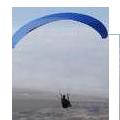
From DHV website about group psychology and skill to fly
by Giuseppe Guglielmi
Scene: a typical wine-bar in the middle of the Palatinate, a region in the south-west of Germany. Leading actor: Karl Slezak, safety consultant of the DHV (German paragliding and hang-gliding federation). Other actors: the members of the "Südpfälzer Gleitschirmflieger Club", the local paragliding association. Karl Slezak is giving a talk about paragliding safety. The video projector beams onto the canvas the picture of a street with a prohibition sign: "No thoroughfare… except for Alois". The attendees burst into laughter. "Except for Alois" was of course hand-written and a very funny idea (for Alois) to avoid a prohibition. Karl Slezak laughs too, but not for long. "Rules are valid for everybody without exception," says Karl Slezak and went on making his point, "Acro flying isn't allowed in Germany as in many other countries, but we have a lot of acro-pilots here." How is it possible? Are there (hand written) exceptions? There is something odd happening in the paragliding scene and Karl Slezak is fighting against it. It's a silent struggle between safety and performance, between people who claim the right to fly just for fun and pilots looking to test their courage.
Karl Slezak does his job with great passion. He committed himself to safety about twenty years ago, as he started flying. In the year 1988 he fell for more than 500 meters during a paraglide flight. Fortunately, he didn't get hurt, but this experience marked his subconscious. As a paraglide instructor, he went on organising the first safety training courses in Germany. "It was a great success," says the man whose nickname soon became Mister Safety, "we had a lot of applications and organised an average of forty courses each year." In the paraglide family he became famous for his research into the interaction between wing and pilot. The appointment as safety consultant of the DHV in year 2001 was the logical consequence of his work. The main point of his job is to compile statistics and analyse accidents, working out details of construction faults and pilots' mistakes. But he has never understood his work as a desktop activity. Quite the opposite: he always tries to look behind the scene of each accident. "When I draw up my annual accidents' report I am always asking myself the same question," Slezak wrote in a fervidly discussed article published a year ago by the DHV members' magazine, "What would happen if pilots at last chose to buy a wing, thinking principally about safety?" And he went on with an even more burning question: "What would happen if pilots admitted that flying with a "DHV 1 classification" paraglide is not a confession of incapability, but the demonstration of what paragliding is for most pilots: fun, enjoyment and freedom without performance pressure and stress". These hypothetical questions hit the nail on the head. Each pilot knows these issues, but only a few have got the boldness to deal with them seriously. That's why Karl Slezak suggests another definition of bravery: "The truly competent pilot is the one who recognises his own limits." A person, on the other hand, who refuses to accept this simple rule, gets himself scared and "nobody is more stupid then someone who spends his spare time being frightened!"
Karl Slezak's new safety concept is a global one. A safety flight is the result of many factors: a suitable paraglide, a good weather forecast and maybe, even more importantly, a sound self-evaluation. "The average paraglider makes 15 flights a year," says Slezak, who has the rare ability to speak about important and sometimes difficult topics in a very easy and comprehensible way. "A DHV 1 paraglide offers the average pilot more potential than he could ever make use of and furthermore also gives him a great reserve of passive safety". Of ninety accidents after a side collapse in the 2003/2004 season, only 8 happened with a DHV 1 or 1-2 and 6 of them where caused by a noverreaction of the pilot. The difference in speed between a DHV 1 and a DHV 2 is only a few km/h and experience shows that nowadays long cross-country flights are possible even with DHV 1 wings. Why then should an average pilot buy a paraglide with an higher classification? Second point: the weather forecast. "Generally, there is no a good or bad weather for paragliding, but there are weather conditions which are good for some pilots and bad for some others". A strong thermal wind in spring could be the beginning of a wonderful cross country flight for an experienced pilot and a nightmare for a beginner. "Why do some pilots voluntarily put themselves in a situation which they are not able to cope with?" The answer for Karl Slezak seems not always to be in the lack of meteorological knowledge but in overestimation of their own skills. And here we have the third point of Slezak's argumentation: "A safe flight begins in the head of a pilot". An example? A dozen pilots are sitting on the starting area waiting for calmer conditions and slacking wind. One of them will soon stand up and take off. "Is the wind getting better? Not at all! It's only the pressure of the group," asserts Slezak. "It is proven that the same pilot wouldn't start if he was alone." Psychology is getting more and more important during pilots' training courses in Germany. Karl Slezak made this a main topic during his speeches and during the preparation courses for paraglide instructors. "We are trying to compensate for lost time. In other flight sports, the importance of psychology was recognised earlier". That's why he decided to attend a safety course for Lufthansa pilots. The German line has long lasting experience with the management of stress situations and the risks of routine in flight. "I was surprised at how openly the pilots spoke about this topic," says the German anti-hero, "a good pilot isn't afraid to show his fear." A similar openness among paraglide pilots is still rare. He is fighting to change this attitude. "Paragliding can become a mass sport only if we manage to change its image of being an extreme sport," emphasises Slezak. "I'm the natural enemy of any pilot who fights for performance above safety and there are a lot of them even within the DHV". Whenn his article about safety was published last year by the official magazine of the German paragliding and hang-gliding federation, the editor put a remarkable picture on the coverage. It shows a well-known German acro-pilot, performing one of his notorious flight manoeuvres. But isn't acro flight forbidden in Germany? Didn't the editor know that? The members of the Südpfälzer Gleitschirmflieger Club, who listened the Slezak's talk, now know the answer: Acro-flight is forbidden in Germany … except for Alois!
Good DHV Article
Moderator: Club Moderators
Good DHV Article
You are only as good as your last flight........
Hopefully also useful
Risk management is, in my opinion, one of the most important ground school topics in paragliding. It is crucial to talk about it in order to create safe pilots and to improve the general safety level of the sport. It is also probably the most difficult topic, as it involves fighting some human tendencies, accepting our limits, thinking for oneself instead of following the grou or trying to attract attention and admiration of other pilots and spectators. It is all about attitude.
There are rules, and the challenge is to follow them in a way that that even if you make a decision that turns out to be a mistake, you still have a margin of safety. When we fly we need to take precautions to make the risks “as low as reasonably practical”. It is always a question of balance between risks and benefits. The figure bellow is a simplistic representation of how we take decisions that involve risk in general, not only in paragliding.
One of the reason it is difficult for us to follow the rules is because of the type of people involved in the sport. I have collected some opinions on the web coming from people around the world answering the question: “why do people like to take risks? The most frequent answers were referring to people who appeared to be:addicted, extremists, daring, enjoy the thrill, new emotions, love of freedom, not conservative, ignore the law… Without discussing all of that in details, it is probably ‘safe’ (!) to say that paragliding pilots are independent people in general, selfish in some ways, who like challenges and like to share their exploits. Marvin Zuckerman, a professor of clinical psychology at the University of Delaware describes adventure/sensation seekers as people who lust after novel, intense experiences and are willing to take any manner of risk (physical, social, legal or financial) to satisfy their urge.
Definition of Risk
(from the article: Sport Parachutist’s safety journal, V2, #2, 1989)
Risk is a measured quantity. It is the product of the probability of something happening and the severity of harm when it does happen. In other words:
“how often” X “how bad”
Probabilities can be divided into 5 categories:
1-frequent
2-probable
3-occasional
4-remote
5-improbable
Severity can be divided into 4 categories:
1-catastrophic
2-critical
3-marginal
4-negligible
For example the risk associated with a having a “wing tip” while flying is “frequent and negligible”. That’s the risk that pretty much every pilot is ready to accept. The risk associated with a “cravate” is more like “remote and critical”. All events in PG could be assigned some risk value based on data collected over many years, on large set of measurements and observations.
The problem is that it is difficult to predict the risk of having an accident because there are too many parameters involved between the conditions, the pilot and the equipment. The other problem is that one flight cannot make you predict what your next one will be. In statistic this is referred to “independent events”. You can flip a coin 100 times, the next time you still don’t know what it is going to be. You can have 100 great flights in a row; you cannot predict what flight #101 will be. This is probably the main problem: some pilots take some risks, they have no accident that day, so they think it is okay to continue taking the same risk on a regular base. Until the accident happens. Very often we hear comments like: “this is a great pilot”, meaning things like: “I am wondering what happened, it cannot be the pilot’s fault, it is bad luck”.
Risk Assessment / Perception
Risk assessment is often based on subjective perceptions of risk. In an interesting article published in Psychology Today (March-April, 2002, by Farrin Jacobs), the author reported that the more experience adventure racers have, the more likely they are to take big risks. But they no longer consider their actions risky. In other words, the more they race, the more their perception of risk changes. This is of course related to their level of confidence. But it does lead to accidents in paragliding.
Prevention of Risk
Okay, now let’s imagine the perfect pilot, flying the perfect site (big launch, big LZ, no obstacles), in the perfect conditions. It is someone who has a complete gear and in good shape. She (it has to be a woman to be so perfect!) is in a good mood today, her ego in general is not interfering with her decisions, the weather is great and there are already some happy pilots in the sky reporting dream conditions with good lift, no turbulence. So, here is our pilot launching, flying far from the ground. What are the risks that an accident will happen? Probably very low. A very un-predictive turbulent mass of air that the pilot will encounter close to the ground, or a collision with someone flying to her from her back? How often is this happening in reality? This is probably hard to tell, but probably not very often. But, what is for sure, is that most of the reported accidents in PG have been described as a pilot error. It used to make me feel better to know that, because then I would think “Of well, I would not have done that, not me”. But after accumulating mistakes myself I had to become more humble. The reality is that we all make mistakes, all the time. So don’t use that as an excuse, it is the worse one. “Oh, she had an accident because she made a mistake”:
The biggest mistake is to think that we won’t make any. We all do.
There is no classification of risks I think, because they are all related to our behavior. The most important fact, by far, is that risks of accidents can be reduced with the right attitude. The main danger in PG is the pilot.
Here are the things that are important to decrease the risks in Paragliding:
1) Mental awareness:
• Acknowledge the risks, don’t deny them.
• Be aware of all the types of accidents that can happen, take all the preventions against them and more importantly admit that we all make mistakes and that’s why you need to follow some safety rules.
• Listen to more experienced pilots advices, pick a good mentor. Chances are that your flying styles will match.
• Assess your mental and physical health
• Know your limits, ie. your level: always ask yourself : “what kind of pilot am I ?”
• Question yourself about series of incidents (forgot your helmet at launch, landed out, disgraceful landing…) and take them as warnings. Make the effort to debrief.
• Listen to your intuition. Get a sense of the site and the conditions for yourself. When in doubt, don’t fly. I think women are better at that. Even though I was surprised to see that in France female pilots have roughly the same percentage of accidents then men (although for some reasons they are less involved in fatal accidents):
2004
2003
Total number of pilots
23242
24094
% female pilots
15%
15%
Number of reported accidents
328 (1.7%)
494 (2%)
Number of accidents involving female pilots
52 (1.5 %)
75 (2%)
Number of accidents involving male pilots
276 (1.3%)
419 (2%)
The following advice comes from Chris Santacroce:
• Be aware of your situation, there are some cycles in your enjoyment: you will have a series of good flights and then some bad flights. Stay aware of where you are in this evolution
• The question is: what does it take to be in an accident? What are the precursors? It is actually not a mystery. There are not so many unlucky accidents. There are warnings, often a sequence of 3 (bad landing the day before, forgot to attach your speed bar, didn’t check the wind strength…).
• Cultivate your mindset, build it to take decisions and develop a way to prepare yourself.
2) Practical advice:
• Use the right equipment and check your equipment all the time.
• Know the preventive or corrective action plans. Benefices of SIV clinics are obvious here.
• Continuing education can only be beneficial.
• Fly far from the ground. Terrain clearance is a key factor.
• Know the weather.
Note that the so-called “intermediate syndrome” is not an exclusivity of intermediate pilots! At all levels we can think we are better pilots then what we are.
Conclusion
Knowledge, skills and attitude are key ingredients to make the sport safer. It is about you as an individual. Even though this is a dangerous sport, if you exercise your new skills and avoid your ego from stopping you in taking rational decisions, you can decrease the risks a lot.
There are rules, and the challenge is to follow them in a way that that even if you make a decision that turns out to be a mistake, you still have a margin of safety. When we fly we need to take precautions to make the risks “as low as reasonably practical”. It is always a question of balance between risks and benefits. The figure bellow is a simplistic representation of how we take decisions that involve risk in general, not only in paragliding.
One of the reason it is difficult for us to follow the rules is because of the type of people involved in the sport. I have collected some opinions on the web coming from people around the world answering the question: “why do people like to take risks? The most frequent answers were referring to people who appeared to be:addicted, extremists, daring, enjoy the thrill, new emotions, love of freedom, not conservative, ignore the law… Without discussing all of that in details, it is probably ‘safe’ (!) to say that paragliding pilots are independent people in general, selfish in some ways, who like challenges and like to share their exploits. Marvin Zuckerman, a professor of clinical psychology at the University of Delaware describes adventure/sensation seekers as people who lust after novel, intense experiences and are willing to take any manner of risk (physical, social, legal or financial) to satisfy their urge.
Definition of Risk
(from the article: Sport Parachutist’s safety journal, V2, #2, 1989)
Risk is a measured quantity. It is the product of the probability of something happening and the severity of harm when it does happen. In other words:
“how often” X “how bad”
Probabilities can be divided into 5 categories:
1-frequent
2-probable
3-occasional
4-remote
5-improbable
Severity can be divided into 4 categories:
1-catastrophic
2-critical
3-marginal
4-negligible
For example the risk associated with a having a “wing tip” while flying is “frequent and negligible”. That’s the risk that pretty much every pilot is ready to accept. The risk associated with a “cravate” is more like “remote and critical”. All events in PG could be assigned some risk value based on data collected over many years, on large set of measurements and observations.
The problem is that it is difficult to predict the risk of having an accident because there are too many parameters involved between the conditions, the pilot and the equipment. The other problem is that one flight cannot make you predict what your next one will be. In statistic this is referred to “independent events”. You can flip a coin 100 times, the next time you still don’t know what it is going to be. You can have 100 great flights in a row; you cannot predict what flight #101 will be. This is probably the main problem: some pilots take some risks, they have no accident that day, so they think it is okay to continue taking the same risk on a regular base. Until the accident happens. Very often we hear comments like: “this is a great pilot”, meaning things like: “I am wondering what happened, it cannot be the pilot’s fault, it is bad luck”.
Risk Assessment / Perception
Risk assessment is often based on subjective perceptions of risk. In an interesting article published in Psychology Today (March-April, 2002, by Farrin Jacobs), the author reported that the more experience adventure racers have, the more likely they are to take big risks. But they no longer consider their actions risky. In other words, the more they race, the more their perception of risk changes. This is of course related to their level of confidence. But it does lead to accidents in paragliding.
Prevention of Risk
Okay, now let’s imagine the perfect pilot, flying the perfect site (big launch, big LZ, no obstacles), in the perfect conditions. It is someone who has a complete gear and in good shape. She (it has to be a woman to be so perfect!) is in a good mood today, her ego in general is not interfering with her decisions, the weather is great and there are already some happy pilots in the sky reporting dream conditions with good lift, no turbulence. So, here is our pilot launching, flying far from the ground. What are the risks that an accident will happen? Probably very low. A very un-predictive turbulent mass of air that the pilot will encounter close to the ground, or a collision with someone flying to her from her back? How often is this happening in reality? This is probably hard to tell, but probably not very often. But, what is for sure, is that most of the reported accidents in PG have been described as a pilot error. It used to make me feel better to know that, because then I would think “Of well, I would not have done that, not me”. But after accumulating mistakes myself I had to become more humble. The reality is that we all make mistakes, all the time. So don’t use that as an excuse, it is the worse one. “Oh, she had an accident because she made a mistake”:
The biggest mistake is to think that we won’t make any. We all do.
There is no classification of risks I think, because they are all related to our behavior. The most important fact, by far, is that risks of accidents can be reduced with the right attitude. The main danger in PG is the pilot.
Here are the things that are important to decrease the risks in Paragliding:
1) Mental awareness:
• Acknowledge the risks, don’t deny them.
• Be aware of all the types of accidents that can happen, take all the preventions against them and more importantly admit that we all make mistakes and that’s why you need to follow some safety rules.
• Listen to more experienced pilots advices, pick a good mentor. Chances are that your flying styles will match.
• Assess your mental and physical health
• Know your limits, ie. your level: always ask yourself : “what kind of pilot am I ?”
• Question yourself about series of incidents (forgot your helmet at launch, landed out, disgraceful landing…) and take them as warnings. Make the effort to debrief.
• Listen to your intuition. Get a sense of the site and the conditions for yourself. When in doubt, don’t fly. I think women are better at that. Even though I was surprised to see that in France female pilots have roughly the same percentage of accidents then men (although for some reasons they are less involved in fatal accidents):
2004
2003
Total number of pilots
23242
24094
% female pilots
15%
15%
Number of reported accidents
328 (1.7%)
494 (2%)
Number of accidents involving female pilots
52 (1.5 %)
75 (2%)
Number of accidents involving male pilots
276 (1.3%)
419 (2%)
The following advice comes from Chris Santacroce:
• Be aware of your situation, there are some cycles in your enjoyment: you will have a series of good flights and then some bad flights. Stay aware of where you are in this evolution
• The question is: what does it take to be in an accident? What are the precursors? It is actually not a mystery. There are not so many unlucky accidents. There are warnings, often a sequence of 3 (bad landing the day before, forgot to attach your speed bar, didn’t check the wind strength…).
• Cultivate your mindset, build it to take decisions and develop a way to prepare yourself.
2) Practical advice:
• Use the right equipment and check your equipment all the time.
• Know the preventive or corrective action plans. Benefices of SIV clinics are obvious here.
• Continuing education can only be beneficial.
• Fly far from the ground. Terrain clearance is a key factor.
• Know the weather.
Note that the so-called “intermediate syndrome” is not an exclusivity of intermediate pilots! At all levels we can think we are better pilots then what we are.
Conclusion
Knowledge, skills and attitude are key ingredients to make the sport safer. It is about you as an individual. Even though this is a dangerous sport, if you exercise your new skills and avoid your ego from stopping you in taking rational decisions, you can decrease the risks a lot.
You are only as good as your last flight........
-
bill-scott
- BHPA Club Coach

- Posts: 1337
- Joined: Tue Dec 27, 2005 11:37 am
- Location: washington
-
gary stenhouse
- Superstar
- Posts: 6288
- Joined: Tue Dec 20, 2005 7:21 pm
- Full Name: Gary Stenhouse
- Location: Company Director
what i do find amazing is the verage pilot only flies 15 flights a year, no wonder it is dangerous in this scenario. i just cant see the point of undertaken a sport that you are celibate in. this is not a sport to be taken litely like it in the article says about mistakes we all make them, after all we are human, but no one sets out to have an accident even though it may of been preventable. after all i you realt want to be safe sit in the house and dont leave and that way you are sure to be safe.
what i would say is so important is the pre flight check reserve glider speed bar. as take off without your bar atached and you are allready 1 third into the incident pit, yet it happens through strees and eagerness to get off.
advis fly as oftern as possible even if it is a fly down, ground handle when you can. remember being nervous on take off is good if your scared ask why? as been nervous is one thing but been scared is not good, as you will not fly well or safely. so if you are scared then dont take off think take a deep breath and ask is it the glider the conditions or just your not sure about flying.
its healthy to be nervous but being scared is not where i like to be even though somedays i get like that, not matter what the wing or conditions.
currency is the only way to get truely confident or inexperience as the less you know the less you worry.
cheers gary
what i would say is so important is the pre flight check reserve glider speed bar. as take off without your bar atached and you are allready 1 third into the incident pit, yet it happens through strees and eagerness to get off.
advis fly as oftern as possible even if it is a fly down, ground handle when you can. remember being nervous on take off is good if your scared ask why? as been nervous is one thing but been scared is not good, as you will not fly well or safely. so if you are scared then dont take off think take a deep breath and ask is it the glider the conditions or just your not sure about flying.
its healthy to be nervous but being scared is not where i like to be even though somedays i get like that, not matter what the wing or conditions.
currency is the only way to get truely confident or inexperience as the less you know the less you worry.
cheers gary
Safety
Both articles came off an Internet search and were exactly what I was exeriencing after a long lay off over winter. ( ie I hadn't flown since October 09)
Some of this stuff seemed relevant to me do it might be the same for others.
Hope it helps.
Some of this stuff seemed relevant to me do it might be the same for others.
Hope it helps.
You are only as good as your last flight........